Your Complete Guide to Choosing the Right UCI Product for Your Project
Introduction – Why Do New Customers Need a Clear Product Map Before Ordering?
Choosing the right insulation product should not begin with the question, “Which product is the cheapest?” The more important questions are: What problem do I need to solve? Where will the product be used? And what are the technical requirements of the project?
When multiple foam and insulation solutions are available, some products may appear similar at first glance while serving completely different purposes. That is why having a clear UCI product guide can help contractors, developers, manufacturers, and end users understand the available categories before making a purchasing decision.
United Insulation Company (UCI) primarily manufactures Low-Density Polyethylene (LDPE) foam products, offering solutions for multiple sectors including flooring, insulation, protection, packaging, and construction applications. The company also highlights its ISO 9001-certified quality management system and commitment to reliable manufacturing standards.
Multiple Products and Similar-Looking Applications
Foam can be used under flooring, in sports surfaces, for product protection, or in construction applications. However, this does not mean that one foam product is suitable for all these purposes.
For example, Carpet Underlay functions as an underlayer beneath flooring, while Shock Pad is designed to absorb impact in sports applications, and Backer Rod is a round foam filler used before sealant application in joints. Each product serves a different purpose, even when the underlying material may be similar.
How Does This Guide Save You Research Time?
Instead of browsing products randomly, you can start with your project type, identify the main challenge, and then move toward the product category that best matches your requirements.
This approach turns the UCI product map from a long product list into a practical decision-making tool.
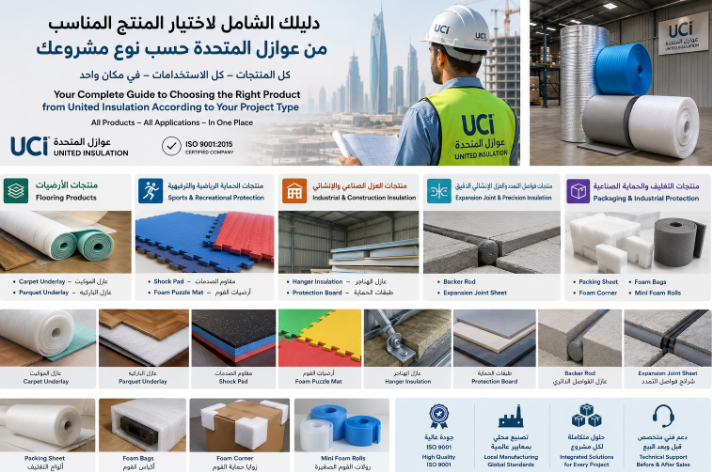
UCI Flooring Products
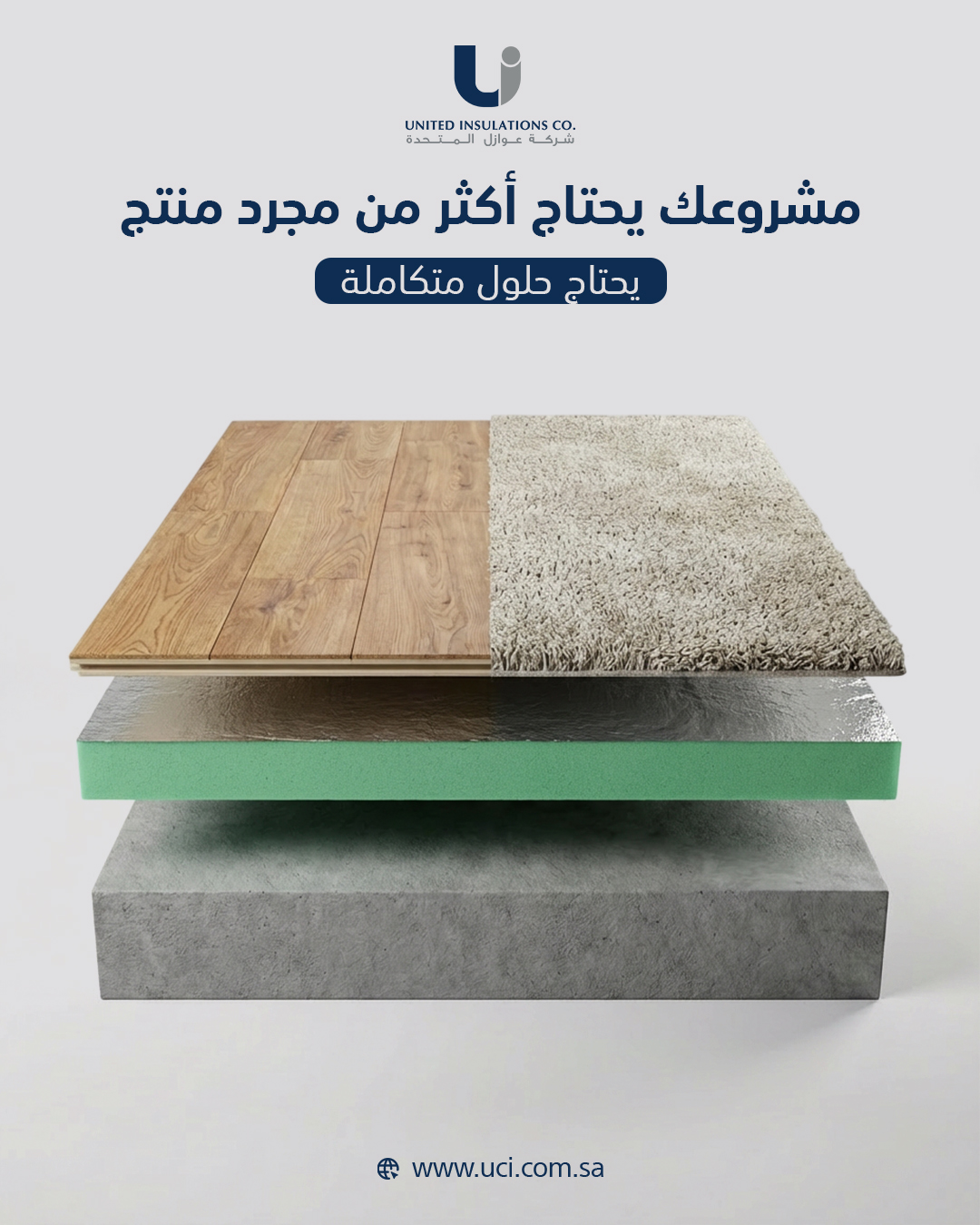
Flooring systems often require supporting layers that go beyond comfort. Depending on the overall system and specifications, these layers can contribute to acoustic and thermal performance and help reduce transmission between flooring layers.
UCI offers flooring solutions including Carpet Underlay and Parquet Underlay. According to the company, Carpet Underlay is used beneath vinyl and carpet flooring, while Parquet Underlay is intended for wooden flooring applications.
Carpet Underlay – Carpet Underlay Foam
Carpet Underlay is used as an underlayer beneath carpet and certain flooring systems such as vinyl. Its basic role is to introduce a foam layer between the subfloor and the finished surface, helping improve underfoot comfort and reduce sound transmission depending on the flooring system and installation method.
UCI states that Carpet Underlay is suitable for residential buildings, hotels, and offices, making it a practical solution for projects where user comfort and flooring performance are important.
Parquet Underlay – Parquet Underlay Foam
Parquet Underlay is designed for wooden and parquet flooring, where the foam layer is installed beneath the finished floor. This underlayer can contribute to improved stability and moisture protection, while also supporting thermal and acoustic insulation within the flooring system.
UCI states that Parquet Underlay provides thermal and acoustic insulation and helps protect wooden flooring from moisture while improving stability.
When Should You Choose Each Product Based on the Flooring Type?
Simple rule: Start with the finished flooring type, then review the installation requirements and technical specifications before approving the product.
Sports and Recreational Protection Products
UCI provides solutions that address different recreational and sports requirements, including Shock Pad and Foam Puzzle Mat.
Not every floor requires the same type of foam. In sports fields and gyms, impact absorption and repeated-use durability are key considerations, while playrooms and recreational spaces often require a softer, safer, and easy-to-install surface.
UCI provides solutions for different sports and recreational needs, including Shock Pad and Foam Puzzle Mat.
Shock Pad – Impact-Absorbing Pad
Shock Pad is a high-resilience foam layer used in sports applications to help absorb impacts generated by movement and repeated use.
UCI describes the product as suitable for sports fields and gyms, with an emphasis on durability, repeated pressure resistance, and safety.
Foam Puzzle Mat – Interlocking Foam Flooring
Foam Puzzle Mat differs from Shock Pad mainly in its intended application. It consists of interlocking foam tiles that are easy to install and are suitable for playrooms and spaces requiring a soft and comfortable surface.
UCI describes the product as soft, safe, and easy to install, making it suitable for creating safer play areas.
The Difference Between Their Use in Sports Fields and Playrooms
Do not choose a product simply because it is called “foam.” Choose it based on the function of the floor.
Industrial and Structural Insulation Products
In industrial and commercial projects, insulation is not limited to flooring. Applications may involve mechanical systems, industrial buildings, structural surfaces, and protecting components during construction.
UCI offers foam solutions for industrial and structural applications, with a focus on performance, reliability, and appropriate application.
Hanger Insulation – Industrial Building Insulation
Hanger Insulation is used in industrial building applications and can also be part of solutions associated with mechanical systems and piping, depending on project design and specifications.
UCI states that Hanger Insulation is used with HVAC and cooling pipes to help prevent condensation and improve thermal performance, making it suitable for industrial and commercial facilities.
Protection Board – Protective Layers
In some projects, insulation alone is not enough. The project may also require protection for layers or components against damage during installation or operation.
This is where protective layers can become important. Depending on the project design and the material being protected, a protection board can form part of an integrated protection system.
Technical note: Thickness, specifications, and installation method should be approved according to the project requirements and the product’s technical data rather than relying on the product name alone.
How Can Both Products Complement Each Other in the Same Project?
The key is to view insulation products as components within a system rather than isolated materials. A project may require thermal or mechanical treatment in one part of the system and protective layers in another.
Expansion Joint and Precision Construction Products
Construction joints require precise solutions because the goal is not simply to fill a gap. The objective is to control how the sealant performs and to create the appropriate geometry inside the joint.
Products such as Backer Rod and Expansion Joint Sheet can therefore be used in joint applications depending on the project design, joint dimensions, and type of sealant.
Backer Rod
Backer Rod
A Backer Rod is a round foam filler placed inside a joint before sealant is applied.
UCI explains that its main role is to help distribute sealant evenly and improve sealing efficiency.
Expansion Joint Sheet
Expansion Joint Sheet
Expansion Joint Sheet can be used as part of expansion joint systems, where the joint material provides appropriate separation and space for movement between structural elements according to the joint design.
The product type, thickness, and dimensions should be selected based on the joint details and the project’s engineering specifications.
When Do You Need Both Products in the Same Joint?
However, using both products together should not be assumed automatically. The correct combination depends on the joint design, movement requirements, dimensions, sealant system, and engineering specifications.
The final decision should be based on the joint details—not simply on the product name.
Industrial Packaging and Product Protection Solutions
When products are sensitive to scratches, impacts, or friction, foam can play an important role in reducing the risk of damage during handling, transportation, and storage.
UCI states that polyethylene foam products can be used to protect sensitive products during transport and storage, while offering multiple protective and packaging solutions.
Packing Sheet
Packing Sheet – Protective Foam Sheets
Packing Sheet is useful when a larger surface area needs to be covered, separated, or protected. It can be placed between or around products to reduce friction and impact during transportation and storage.
This type of solution is particularly useful when products are larger or when the packaging process requires flexibility in cutting and shaping the material around the product.
Foam Bags
Foam Bags – Protective Foam Bags
Foam Bags provide a practical way to protect small and medium-sized products that require lightweight and efficient packaging, especially items that may be exposed to scratches or friction during handling and transportation.
Their advantage is the availability of a ready-to-use protective layer, reducing the need to cut foam manually for every individual item.
Foam Corner
Foam Corner – Corner Protection
Product corners are among the areas most vulnerable to damage during transportation and storage, especially for items with rigid surfaces or exposed edges.
Foam Corner can therefore provide additional protection around corners and edges, helping reduce the impact of direct contact and handling.
Mini Foam Rolls
Mini Foam Rolls – Compact Foam Rolls
Mini Foam Rolls are useful when a business needs flexible, repeated, or smaller-scale product protection.
UCI describes Mini Foam Rolls as suitable for protecting shelves, drawers, and fragile items from damage and scratches.
How Do You Choose the Right Format Based on Your Product and Business Size?
Start with three questions:
Do you need to cover a large surface?
Sheet-based solutions are generally more practical when a large surface area requires protection.
Is the product small and does it require fast packaging?
Foam Bags or Mini Foam Rolls may be more practical depending on the product.
Are the corners the most vulnerable areas?
Consider dedicated corner protection such as Foam Corner.
How to Choose the Right Product in 3 Simple Steps
Choosing the right insulation product does not have to be complicated. You can quickly narrow down your options by identifying the project type, the main challenge, and the technical requirements.
Identify Your Project Type
Start by asking: Where will the product be used?
Identify the Main Challenge
After identifying the project, define the problem you need to solve:
- Heat: identify the solution suitable for the required thermal performance.
- Sound: identify the product that can contribute to reducing sound transmission within the flooring or building system.
- Impact: consider solutions designed for impact absorption, such as Shock Pad in suitable applications.
- Product protection: compare sheets, bags, corners, and rolls based on product shape and sensitivity.
- Joints and movement: review solutions such as Backer Rod and other joint products according to the engineering details.
Consult the Technical Team Before Ordering
If you are unsure between several products, do not make your decision based only on the product name, image, or price.
Share information such as the project type, application, dimensions, quantity, installation method, and surrounding conditions with the technical team. The more precise the information, the easier it becomes to identify the appropriate solution.
Why Do Saudi Projects Rely on UCI for These Product Categories?
Using one supplier for multiple requirements can reduce administrative complexity, especially when different products are needed across various stages of construction, protection, or packaging.
UCI positions itself as a Saudi manufacturer specializing in low-density foam solutions, with a broad product range and technical support for projects.
Saudi Manufacturing with ISO 9001 Standards
UCI states that it holds ISO 9001 Quality Management System certification, a standard focused on process management, quality improvement, operational efficiency, and meeting customer requirements.
The company also highlights quality-control systems and product testing before delivery.
The Ability to Supply Multiple Products for One Project
A single project may require multiple solutions: a flooring underlayer, protection for specific components, packaging foam, or joint-related products.
Having multiple product categories under one supplier can simplify communication and coordination and give the project team a single point of contact for discussing different requirements.
Unified Technical Support Across Product Categories
Technical support can be just as important as the product itself, particularly for solutions whose performance depends on correct selection and installation.
UCI states that its technical team provides consultations and helps customers select suitable solutions from planning through execution.
Common Mistakes When Choosing Foam and Insulation Products
Choosing a Product Based Only on Price
The lowest-priced product may appear more economical initially, but choosing an unsuitable solution can result in higher costs through replacement, rework, or project delays.
Using One Product for Every Application
Not every foam product is suitable for every application.
Flooring requirements can differ from sports applications, while product protection requirements differ from construction joints. The product should therefore always be matched to its intended function.
Ignoring Installation Requirements
Even a high-quality product may fail to deliver the expected result if installed incorrectly.
For this reason, installation instructions, technical data, dimensions, and environmental conditions should be reviewed before implementation.
Ordering Before Determining the Required Quantity
For large projects, knowing the product name is not enough. You should determine the required area, number of pieces, joint lengths, or packaging volume before calculating the required quantity.
The UCI Product Map in One Place
The UCI product guide can be summarized in a practical product map as follows:
This map does not mean that a product should automatically be approved for every project. Instead, it helps you identify the right category first, after which the technical specifications, quantity, and installation requirements should be confirmed with the UCI team.
How Should You Compare UCI Products Before Ordering?
Instead of comparing products based only on price or thickness, evaluate them according to:
Where will the product be installed or used?
Is the goal insulation, impact absorption, protection, sound reduction, or joint treatment?
Will the product be exposed to moisture, heat, pressure, or repeated use?
What thickness, dimensions, quantity, and installation method are required?
Does the product meet the project’s required specifications?
Can the supplier provide the required quantities on time, and is technical support available?
When Should You Start Looking for the Right Product?
Choosing the right insulation product should ideally happen before installation begins—during the design, planning, or bill-of-quantities stage.
The earlier the product is identified, the easier it becomes to compare alternatives, estimate quantities, review specifications, and avoid changing the solution midway through the project.
UCI recommends considering the supplier and insulation solution during design, pre-construction, and tender comparison stages rather than leaving the decision until the last minute.
Conclusion – The Right Product in the Right Place Helps Prevent Future Costs and Mistakes
Choosing the right product is not about how many products are available. It is about understanding what each product is designed to do and where it should be used.
If your project involves flooring, start with Carpet Underlay or Parquet Underlay depending on the flooring type. For sports applications, begin by evaluating Shock Pad. For playrooms, consider Foam Puzzle Mat. For joint applications, review Backer Rod and expansion-joint solutions based on the project details.
For packaging and protection projects, choosing between Packing Sheet, Foam Bags, Foam Corner, and Mini Foam Rolls depends on the product size, shape, vulnerable areas, and transportation and storage method.
Most importantly, do not make price your only decision criterion. Selecting the right solution early can help reduce rework, improve execution efficiency, and minimize risks associated with using an unsuitable product.
If you are still unsure between several options, start by identifying your project type \+ main challenge \+ application conditions, then share these details with the UCI technical team to receive appropriate guidance.
Explore All UCI Products in One Place
Contact UCI If You Are Choosing Between Multiple Products
You can contact UCI to discuss your project requirements and review the most suitable product before ordering.
Request Technical Guidance to Select the Right Solution
UCI provides technical support and consultation to help customers identify suitable solutions for their projects.
Frequently Asked Questions About the UCI Product Guide
How Do I Know Which UCI Product Is Right for My Project?
Start by identifying your project type, intended application, and main challenge. Then review the product specifications, installation method, and required quantity. If multiple options appear suitable, consult the technical team before ordering.
Can More Than One UCI Product Be Used in the Same Project?
Yes. A single project may require multiple products, particularly large projects combining flooring, protection, packaging, or construction applications. However, compatibility and installation should be confirmed according to the project requirements.
What Is the Difference Between Shock Pad and Foam Puzzle Mat?
Shock Pad is primarily designed for sports applications to help absorb impact, while Foam Puzzle Mat consists of interlocking foam tiles suitable for playrooms and recreational spaces.
What Is the Difference Between Backer Rod and Expansion Joint Sheet?
Backer Rod is a round foam filler placed inside a joint before sealant application to help control the sealant geometry, while Expansion Joint Sheet is used as a separation component within an expansion-joint system according to the project design.
Does UCI Provide Technical Consultation Before Ordering?
UCI states that its technical team provides consultation and helps customers select suitable project solutions, and the company invites customers to request technical consultation.
Which Products Are Suitable for Protecting Products During Transportation?
The choice depends on the product’s size, shape, and packaging method. Solutions such as Packing Sheet, Foam Bags, Foam Corner, and Mini Foam Rolls can be considered depending on whether you need surface coverage, full product protection, corner protection, or flexible reusable protection.
Are All UCI Products Made from the Same Type of Foam?
UCI specializes primarily in Low-Density Polyethylene Foam (LDPE) products, but applications, specifications, and final product designs vary according to the intended use.
Why Should the Product Be Selected Before Installation Begins?
Selecting the product early allows the project team to review specifications, estimate quantities, compare alternatives, and confirm that the solution fits the design before installation begins.
Product requiring transportation protection? → Identify the vulnerable area → Sheet, Bag, Corner, or Roll.
The most important rule: the right product is not necessarily the thickest or cheapest one. It is the product that matches the project function, technical requirements, and intended application.
The UCI product guide should start with your project needs—not with a product name.
Related posts:
 How to Order Industrial Warehouse Insulation? A Complete Guide to Choosing the Best Hangar Insulation in Saudi Arabia
  A Comprehensive Guide to Choosing the Right Insulation Materials for Your Project
  Guide to Choosing Thermal Insulation Foam Boards by Project Type
  Procurement Manager’s Guide to Choosing the Right Industrial Packaging Supplier