Saudi Arabia’s hot and dry climate presents one of the greatest challenges for energy efficiency in modern construction. With summer temperatures often exceeding 45°C, proper thermal insulation has become essential for maintaining comfortable indoor environments and reducing electricity consumption.
Since its establishment, United Insulation Company (UCI) has led the thermal insulation industry in Saudi Arabia by providing innovative, high-quality, and sustainable insulation solutions. As a proud Saudi manufacturer, UCI supports Vision 2030 by delivering products that enhance energy efficiency, minimize waste, and contribute to building sustainable communities.
Studies show that air conditioning accounts for more than 60% of total energy consumption in Saudi residential buildings. However, with proper thermal insulation, energy use can be reduced by up to 40%, creating more efficient and comfortable living spaces.
Thermal insulation acts as a barrier to heat transfer, maintaining a stable indoor temperature and reducing the load on air conditioning systems. This means:
Thermal insulation refers to using specialized materials that limit the transfer of heat between the interior and exterior of a building. These materials are categorized based on their placement and function.
Your choice depends on the project’s location and climate. Roof insulation is essential for warehouses, villas, and factories, while wall insulation enhances comfort in residential and hospitality projects.
Choosing the right insulation material depends on factors such as density, thermal performance, water resistance, and cost. Below are the most common and effective materials used in Saudi projects.
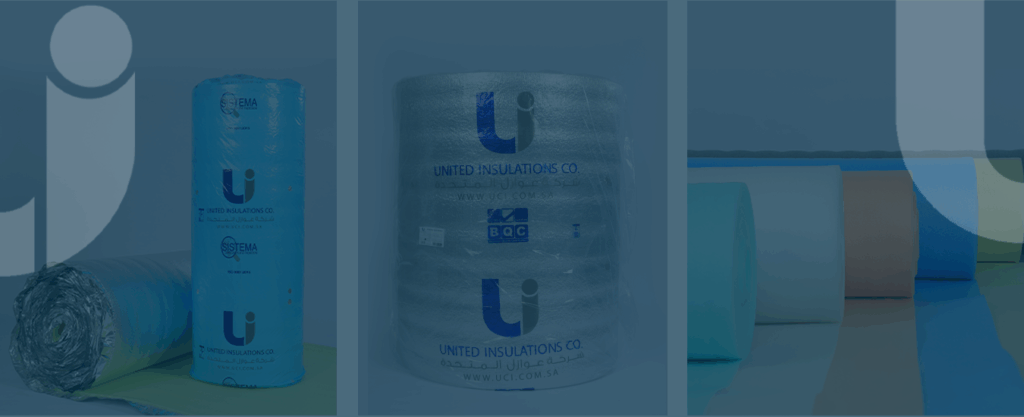
Lightweight, flexible, and moisture-resistant, Polyethylene Foam (LDPE) is one of the most advanced materials for thermal and acoustic insulation.
At United Insulation Company (UCI), LDPE Foam is manufactured using state-of-the-art technology and strict quality control to ensure:
📍 Learn more about UCI Polyethylene Foam
Used for roof and wall insulation, these boards are known for being lightweight and easy to install:
A natural insulation material made from basalt rock fibers, offering:
A modern solution where liquid foam is sprayed and expands to form a seamless insulating layer.
➤ Perfect for irregular surfaces and hard-to-reach areas.
| Material | Density (kg/m³) | Heat Resistance | Price Range | Main Advantages |
| Polyethylene Foam | 25–35 | Excellent | Medium | Water-resistant and flexible |
| Polystyrene (XPS) | 30–40 | High | Medium–High | Strong thermal stability |
| Rock Wool | 40–80 | Very High | High | Fire-resistant |
| Spray Foam | Variable | Excellent | High | Seamless coverage |
Installing thermal insulation in homes helps:
In industrial facilities, UCI’s specialized insulation systems — such as
Warehouse Insulation Solutions — offer:
Proper insulation of foundations and walls prevents heat transfer from the ground and improves building longevity — particularly vital for large commercial complexes, hotels, and infrastructure projects.
Insulation materials must withstand extreme heat without losing performance.
Premium insulation maintains its effectiveness for years, even under harsh weather conditions.
Quick installation and reasonable costs make certain materials ideal for large-scale developments.
Designed for industrial structures, UCI’s Hanger Insulation prevents condensation and reduces heat transfer.
📍 Explore more:UCI Hanger Insulation
UCI’s Protection Layers provide an extra barrier against both heat and moisture, ensuring longer structural durability.
Combining thermal efficiency, acoustic performance, and moisture resistance, this product is a cornerstone of modern, sustainable insulation systems.
Different regions of Saudi Arabia require different insulation densities and materials.
A professional engineer can recommend the optimal thickness and installation method for your project.
All UCI products are manufactured according to SASO specifications, guaranteeing safety and performance.
Polyethylene Foam (LDPE Foam) is considered one of the best options due to its durability, moisture resistance, and high thermal performance.
Yes — it can cut air conditioning energy use by up to 40%, resulting in significant cost savings.
High resistance to heat and humidity, long-lasting stability, and easy installation.
Between 15 to 25 years, depending on material quality and proper installation.
Yes, United Insulation Company provides engineering consultations and customized design support to ensure optimal insulation performance.
Thermal insulation blocks heat transfer, while waterproof insulation prevents moisture and water infiltration.
In Saudi Arabia’s challenging climate, thermal insulation has become essential for achieving energy efficiency, comfort, and sustainability in modern buildings.
Choosing the right material — such as UCI’s Polyethylene Foam — guarantees long-term performance, improved energy savings, and enhanced building protection.
 Thermal Insulation for Concrete Roofs – Best Methods and Materials
 United Insulations Company (UCI) – Leading the Insulation Industry in Saudi Arabia and the Gulf
 Industrial Insulation in Saudi Arabia – Advanced Energy Efficiency Solutions for Modern Projects
 Types of Foam in the Saudi Market and a Comparison of Their Properties and Uses